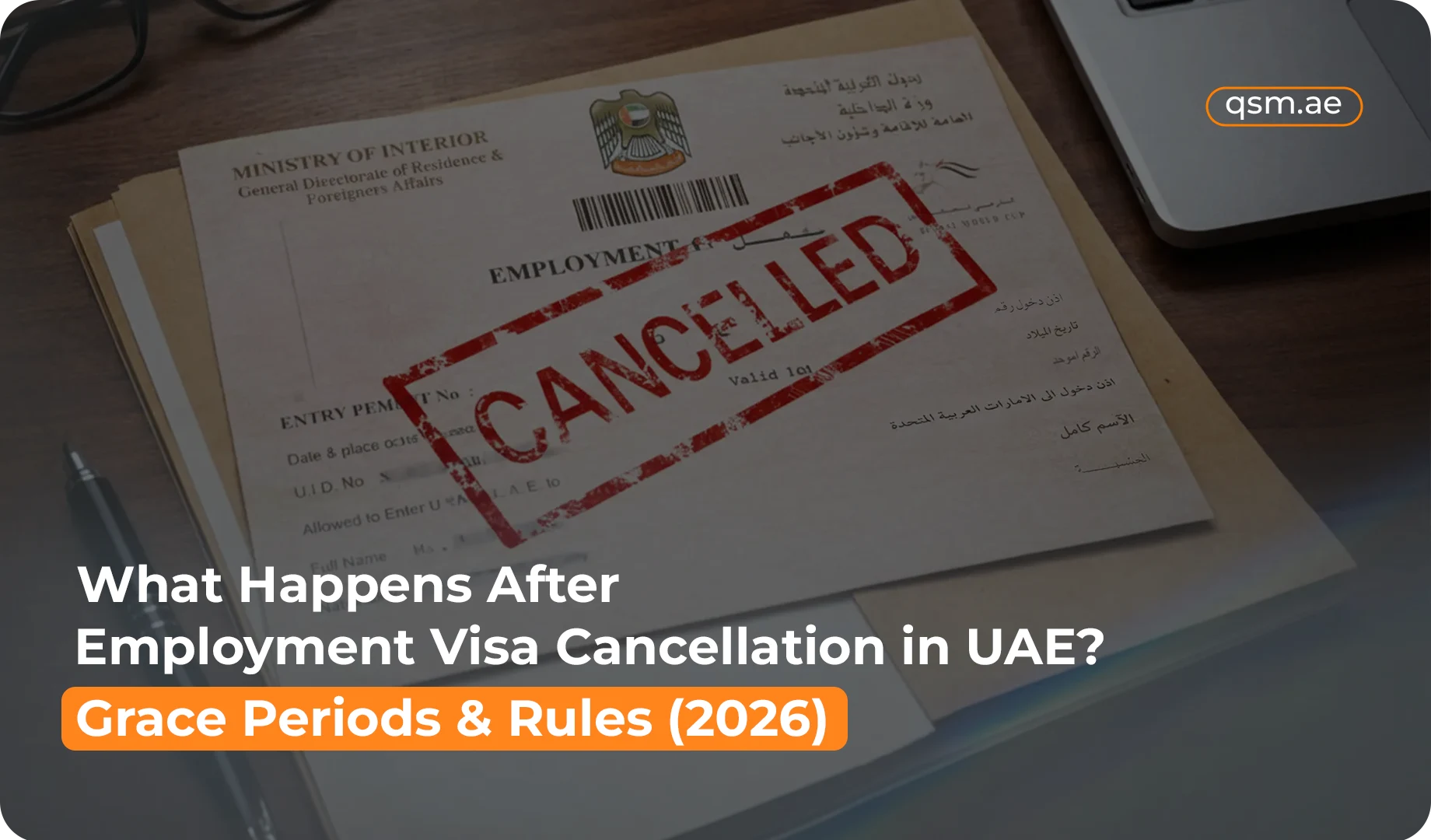

Quick Answer: After cancellation of employment visa in UAE, you receive a grace period of 30 days to either depart the country, find a new employer and transfer your visa, or change your visa status. If you stay beyond this window without a valid status, overstay fines in UAE after cancellation apply at AED 50 per day, plus a one-time AED 200 exit permit processing fee. The rules after visa cancellation in UAE vary slightly depending on whether the visa was stamped, the type of cancellation, and the emirate of sponsorship.
Losing a job or ending an employment contract in the UAE raises immediate questions about what comes next.
Many residents are unsure how much time they have, what their options are, and what happens if things do not move as quickly as planned.
The situation is manageable when you understand the rules after visa cancellation in UAE clearly and act within the right timeframes.
This guide covers everything that happens after cancellation of employment visa in UAE in 2026, including the grace period, your available options during that window, what fines apply if you overstay, and special situations such as cancellation before stamping or disputes with an employer.
The Employment Visa Cancellation Process: A Quick Overview
Before getting into what happens after the cancellation, it helps to understand how the employment visa cancellation process unfolds, because the grace period clock only starts once the cancellation is officially processed in the system.
The employment visa cancellation process for private sector workers begins with the employer submitting a cancellation request through MOHRE (Ministry of Human Resources and Emiratisation).
MOHRE reviews the labour record and confirms that end-of-service entitlements have been addressed and that no unresolved complaints are pending from either side. Once MOHRE clears the record, the immigration cancellation is submitted to ICP or GDRFA depending on the emirate of sponsorship.
The sponsor’s authorised representative confirms the request, and ICP or GDRFA formally cancels the residence visa. The date on which ICP or GDRFA processes the cancellation is the date from which the grace period begins.
For free zone employees, the process runs through the relevant free zone authority rather than MOHRE, but the immigration cancellation still goes through ICP or GDRFA and the grace period rules are the same.
Grace Period After Visa Cancellation UAE 2026: What You Get
The UAE no longer applies a single fixed grace period to all residents. In 2026, the grace period after visa cancellation depends on your visa category, skill level, and employment type. The window you receive determines how long you can legally remain in the UAE after your employment visa is cancelled before overstay fines begin.
The grace period applies regardless of how long you held the visa, whether the cancellation was voluntary or employer-initiated, and whether you are in the UAE or abroad when the cancellation is processed.
During this window, you have three main paths available to you. You can depart the UAE and return on a visit visa or new employment visa at a later date. You can find a new employer and initiate a visa transfer or new employment visa under the new sponsorship. You can also change your visa status within the UAE to another category, such as a spouse visa, investor visa, student visa, or a freelance permit, depending on your eligibility.
The grace period after visa cancellation UAE 2026 is not extendable under standard circumstances. If the window is not enough due to a genuine emergency or ongoing legal dispute, reaching out to ICP or the relevant immigration authority before the deadline is the recommended course of action rather than allowing the period to lapse silently.
Flexible Grace Periods Based on Visa Type
The UAE now applies differentiated grace periods depending on your visa category, professional classification, and employment type. Understanding which category applies to you is the first step before calculating any deadline or making decisions about your next move.
30 Days: The standard grace period for most private sector employees and domestic workers. This is the default window that applies to the majority of employment visa cancellations processed through MOHRE. If you are unsure which category you fall under, assume 30 days until you confirm otherwise.
60 Days: Available to skilled professionals under certain visa categories. This includes residents holding specialised talent permits, certain technical or professional classifications, and employees in designated high-skill occupations. ICP confirms eligibility at the point of cancellation.
90 Days: Available to select investors, property owners, and dependants under certain family sponsorships. Residents who hold investor visas, property-linked residency, or who are dependants under qualifying long-term sponsorship arrangements may be eligible for this extended window.
If you are unsure which grace period category applies to your visa, check your status through the ICP Smart Services portal or contact an authorised document clearing service before assuming the standard 30-day window applies to you.
Grace Period Calculation Examples
Understanding how the days are counted helps you plan your next steps accurately and avoid fines that could have been avoided with a clear calculation from the start.
30-day example: If your visa is cancelled on 1 March 2026 and you are eligible for a 30-day grace period, your legal stay ends on 31 March 2026. You must secure a new visa or exit the UAE before this date to avoid the AED 50 daily fine.
60-day example: If your visa is cancelled on 1 March 2026 and you qualify for the 60-day skilled professional grace period, your legal stay extends to 30 April 2026. Any day beyond that without a valid status attracts the AED 50 daily overstay fine.
90-day example: If your visa is cancelled on 1 March 2026 and you qualify as an investor or property owner, your legal stay extends to 29 May 2026.
Important: Grace period days are counted as calendar days, not working days. Weekends and public holidays are included in the count. The clock does not pause for any reason once it starts from the official cancellation date recorded by ICP or GDRFA.
Overstay Fine in UAE After Cancellation: What You Will Pay
If you remain in the UAE beyond your grace period without a valid visa or status change in progress, overstay fines in UAE after cancellation begin to accumulate immediately.
The current overstay fine in UAE after cancellation is AED 50 per day from the first day after the grace period expires. This amount accumulates daily with no cap on the total, meaning a prolonged overstay can result in a significant financial liability.
In addition to the daily fine, a one-time AED 200 exit permit processing fee applies when you settle your overstay and prepare to depart. An entry ban may also be imposed depending on the length and circumstances of the overstay, which can affect your ability to return to the UAE in the future.
Overstay fines in UAE after cancellation must be settled in full before you can depart the country or apply for a new visa. If you realise you have overstayed, the right step is to visit the nearest ICP Customer Happiness Centre or GDRFA office, declare the overstay, pay the accumulated daily fines along with the AED 200 exit permit fee, and obtain a departure permit.
Attempting to leave without clearing the fines at the airport will result in the fines being flagged at the immigration counter and payment being required before you are permitted to board.
Your Options During Your Grace Period
The grace period after cancellation of employment visa in UAE is more than just a countdown to departure. It is a period during which you have genuine flexibility to decide your next move. Understanding each option in full helps you make the right choice for your situation.
Departing the UAE: If you do not have a new job lined up or another visa category to transfer to, departing within the grace period is the cleanest option. You can return to the UAE later on a visit visa while continuing your job search, or re-enter on a new employment visa once one is secured. There are no penalties for departing before the grace period ends.
Transferring to a new employer: If you have secured a new job, your new employer can initiate a work permit and visa transfer application while you are still within the grace period. In many cases this process is completed within the window, allowing you to stay continuously without departing. The new employer submits the application through MOHRE and ICP, and once approved your status is updated in the system.
Changing visa status: If you are eligible for another visa category, the grace period allows you to apply for a status change without leaving the country. Common transitions include moving to a spouse or family visa if your partner holds a UAE residence visa, applying for an investor or partner visa if you have a business in the UAE, or switching to a student visa if you are enrolling in an accredited institution. Freelancers can also apply for a freelance permit or self-employment visa during this window.
Applying for a job seeker visa: The UAE introduced a job seeker visa that allows eligible candidates to remain in the UAE for a set period while actively looking for employment. If you meet the eligibility criteria, applying for this visa during the grace period is a valid way to extend your legal stay without accruing overstay fines.
Rules After Visa Cancellation in UAE: What You Must Know
Beyond the grace period and fines, several important rules after visa cancellation in UAE affect your day-to-day status and obligations during the transition period.
Your Emirates ID becomes invalid on the date your residence visa is cancelled. You should not use your Emirates ID for any official transaction after cancellation, as it is no longer recognised as a valid identity document in government systems. Your passport remains your valid travel and identity document during the grace period.
Your bank accounts and financial products in the UAE are linked to your residency status. Some banks require you to notify them of a visa cancellation and may request updated residency documentation within a set period. If you are departing the UAE permanently, settling outstanding loans, credit cards, or financial obligations before leaving is strongly advisable, as UAE banks and courts can pursue recovery through international channels.
Health insurance linked to your employment visa is typically cancelled alongside the visa. If you need medical attention during the grace period, confirm your coverage status with your previous employer’s HR department or arrange a short-term policy independently.
If you have dependants on your visa, their residence permits are not automatically cancelled when your employment visa is cancelled.
You are responsible for cancelling each dependant’s visa separately and ensuring they are covered by the same grace period rules or transferred to another sponsor before that period ends.
Cancel Employment Visa Before Stamping: What Happens
A common situation that causes confusion is when a visa has been approved and issued but not yet stamped in the passport. Understanding the rules around cancel employment visa before stamping helps avoid unnecessary complications.
If an employment visa is cancelled before stamping, the situation is straightforward from a residency standpoint. Since the visa was never stamped, no active residency status was established, and technically no grace period applies in the traditional sense.
However, an entry permit or pre-approval may have been issued, and that document must also be formally cancelled through the employer and the relevant immigration authority to ensure the record is clean in the system.
If you entered the UAE on an entry permit tied to the new employment visa and the visa is subsequently cancelled before stamping, you will be treated as holding a visit entry status. The standard rules for that entry category apply, and you should confirm your exact legal status with ICP or GDRFA before making any decisions.
In any case involving cancel employment visa before stamping, seeking clarification directly from ICP or through a document clearing service is the safest approach to avoid a status gap.
What If the Employer Cancels Your Visa Without Notice
One of the most stressful scenarios is discovering that an employer has initiated the employment visa cancellation process without informing the employee. This does happen, and the rules after visa cancellation in UAE provide clear channels for addressing it.
If your visa has been cancelled without your knowledge or consent, the first step is to check your visa status online through the ICP Smart Services portal or the GDRFA Dubai portal using your passport number or Unified Number.
If cancellation is confirmed, note the cancellation date so you know exactly when your grace period began.
If the cancellation was processed without the correct MOHRE procedures being followed, or if end-of-service entitlements were not paid, you have the right to file a complaint through MOHRE.
The MOHRE complaint process is available online and at MOHRE service centres. Filing a complaint does not automatically halt the immigration cancellation, but it initiates a formal process to recover any entitlements owed and creates a legal record of the dispute.
Employees who believe their visa was cancelled unfairly or in retaliation for raising a complaint can also approach the Ministry of Human Resources and Emiratisation for guidance.
The UAE labour law framework provides significant protections for employees in these situations.
After Cancellation of Employment Visa in UAE: A Summary Checklist
Knowing what to do and in what order after cancellation of an employment visa in the UAE prevents avoidable fines, status gaps, and complications with future visa applications.
Confirm the official cancellation date by checking your status on the ICP Smart Services portal or GDRFA portal. This is the date your grace period starts.
Confirm which grace period category applies to your visa, 30, 60, or 90 days, before calculating your deadline.
Download and save your electronic visa cancellation document from the relevant portal as proof of cancellation. Notify your bank of the visa cancellation if required by your account terms. Cancel or transfer your dependants’ visas before the grace period ends.
Decide on your next step, whether departing, transferring to a new employer, or changing visa status, and begin the necessary applications as early as possible within the grace period window.
If you have outstanding end-of-service payments or labour disputes, raise them through MOHRE promptly and do not delay this until after departure, as resolving MOHRE matters from outside the UAE is significantly more difficult.
Conclusion
Understanding what happens after cancellation of employment visa in UAE takes the uncertainty out of a situation that already involves enough stress.
The flexible grace period system in 2026 means your window may be 30, 60, or 90 days depending on your visa category. Knowing which applies to you is the first step to planning correctly and avoiding the AED 50 daily overstay fine and AED 200 exit permit fee that apply the moment your grace period ends.
The rules after visa cancellation in UAE are clear, and acting within the stated timeframes protects you from financial penalties and any longer-term consequences such as entry bans.
The employment visa cancellation process is largely driven by your employer and the government authorities, but the responsibility for what happens next sits with you. Confirming your status, identifying your grace period category, downloading your cancellation document, and making a decision within the deadline are the actions that matter most.
For residents navigating a complicated cancellation, an employer dispute, or an urgent visa transfer, QSM Document Clearing Services manages the process from cancellation to new status, ensuring nothing falls through the cracks. Contact our team to get started.